In June, I wrote a Voices Blog piece to share more with our community about how we make our budgetary decisions at CICS and what the incoming federal relief dollars might mean for how we support our schools, teachers, and students this school year.
Now, a few months into this school year, I have the pleasure of being able to follow up on my piece and share more about our priorities, our spending, and most importantly, the impact we hope to see from this landmark investment in our schools.
Overall, CICS received funds from three federal relief bills passed in 2020 and 2021: the CARES Act in April 2020; the Coronavirus Relief Bill in December 2020; and the American Rescue Plan Act in March 2021. The most recent of these relief packages, the American Rescue Plan Act, resulted in an influx of approximately $7.7 million to invest across all 13 CICS campuses. While each SMO and schools had the autonomy to spend their dollars as they deemed necessary, I know we were all united around the common priorities and values that drive decision-making across our network.
To ensure every student in the CICS community can flourish, we had to ask ourselves some important questions before allocating these dollars. How do we get our kids back into schools safely on a full-time basis? Once they’re there, how do we keep kids and teammates safe in our schools without taking away dollars from instruction? And, perhaps most importantly, how do we use funds to equally prioritize both social-emotional health and academic recovery?
The answers to these questions are what ultimately drove our spending decisions. I am eager to share some of the big ways we invested our dollars:
The above priorities certainly don’t fully encompass all the ways that we have leveraged this $7.7 million in additional dollars for our students. However, I hope they have given you a window into how we translate these priorities into concrete expenditures. And, perhaps more importantly, I hope they give you insight into the kinds of impact we hope to see in the months and years ahead.
If we invest in the tools and resources to keep our communities safe, we can mitigate dangerous exposures before they start and instead focus on rebuilding our communities and supporting learning. If every student has a laptop and access to both in-person and virtual instruction, we know learning can continue despite any obstacles. If we acknowledge the challenges facing our schools in terms of staffing and capacity, and innovate around personnel accordingly, we can help provide some much needed relief. And if we are constantly learning about and investing in our students’ needs – both academic and social-emotional – then we know we can set them on a path towards seizing the kinds of successful futures they each deserve.
As I mentioned in June, an organization’s budget and spending tells the story of what matters to them. I hope in communicating a little more about how CICS has spent these precious federal relief dollars, you now have better insight into the concrete ways we are prioritizing our schools, teachers, and students during this landmark school year.
I believe that an organization’s budget is so much more than numbers on a screen. Budgets tell a story. They tell the story of what an organization cares about; what they’re prioritizing; and over time, how they plan to grow and evolve. Ask me what’s important to an organization and I’ll tell you by looking at their budget.
What I Learned from CICS Wrightwood Still Applies to Me Today
I have now been at the University of Wisconsin-Madison Law School for over two years! As a native south side Chicago African-American woman, and CICS Wrightwood graduate, I have come a long way from home.
Since I started law school in the fall of 2019, I’ve learned about myself and the legal profession. Although law school is unlike any other schooling I have experienced, my ease at transitioning to law school can be attributed to my experiences as a student at CICS Wrightwood.
Mrs. Ebony Blair-Jones’s 6th grade students at CICS Wrightwood are regularly asked to complete two projects a month in their social studies and science classes that focus on a particular theme. In honor of Black History month, she wanted her students to look beyond slavery and recognize the contributions that their culture has had on today’s society. The two projects Ms. Blair-Jones class created were to help her students to not only own their history but also to educate others.
The first option was to create a virtual museum titled, “Honoring our Past." Students were provided a list of focus areas that included literature, music, military and politics where African Americans have made significant contributions. They had to research the notable icons they chose and, using credible resources, create a virtual museum with samples of what their selected icons had done.
Brooklyn Nailer’s virtual museum included notable African Americans such as singer and activist Nina Simone, writer and poet Maya Angelou, as well as the all-Black Illinois 8th Infantry Regiment founded in the 1870’s who later fought in WW1 as the 370th Infantry in France.
The second option for students asked them to create a non-profit organization with a business plan that would preserve African American history, support the local community and also inform others of the rich history of African Americans contributions in the US.
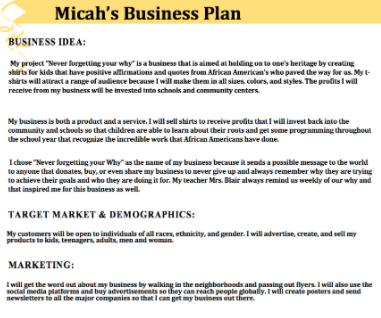
Micah Eversley’s proposal was to open a non-for-profit t-shirt business. The organization’s t-shirts would be emblazoned with quotes and pictures of famous African Americans. In this way, Micah believes that other students will be able to honor persons who have paved the way for them and also inspire those earing the t-shirts to do great things in their own future.
Mrs. Blair-Jones’ goal for these projects is to “encourage self-learning and self-love through a hands-on approach that requires my students to be able to do research, become critical thinkers and to always value and appreciate who they are and where they came from.” Celebrating Black History Month through Project-Based Learning is one of many ways students can learn the many contributions of African Americans in the United States. What a great way to celebrate past, present, and future notable African Americans!
Mrs. Ebony Balir-Jones has a BA in Elementary Education from Chicago State University and a Master in Higher Education Administration. She is currently completing her Certification in Special Education with an expected graduation date of May 2021. She is also the mother of two children, a three and an eight year old.
In honor of Black History Month, we want to continue profiling educators, staff and students who make a difference at CICS. This week we would like to profile, Ms. Lentoya Stennis. She is the new CICS Lloyd Bond Office Manager. Read her story and why she loves working in education and at Lloyd Bond.
Lentoya Stennis is the office manager at CICS Lloyd Bond. Ms. Stennis has always loved education and considered becoming a school counselor or a teacher but knew that teaching wasn’t for her. “I am a forever student,” she said. “I am someone who needs to know and make sense out of the things around me and I love helping other people reach that moment.” She found her place working in administrative roles at schools. She first met Lloyd Bond School Director Tyson Daniel when she worked in Student Supports Services several years ago at CICS Loomis-Longwood. So when Ms. Daniel contacted her, she jumped at the opportunity to return to CICS.

For Ms. Stennis, being an administrator is almost like being a teacher, especially when she is surrounded by kids when schools are in-person. During remote learning, she has stepped into the role of organzing virtual events for students including the Bengal Café, “Where only love and good vibes live.” During the first week of Black History Month, Lloyd Bond, held a Wednesday celebration where 30 participants had the opportunity to hear poems from Paul Laurence Dunbar as well as original pieces read by Bond educators and staff members. Bond teachers, Ms. Pearman and Ms. Robinson, created a video of first graders reciting “Hey Black Child'' a poem by Countee Cullen. At the conclusion of the virtual event, Bond 5th grade teacher Ms. Morris stole the show with her lead-in and presentation of Langston Hughes’ poem “Mother to Son”.
For Ms. Stennis, hosting these events are just another way to put something of herself into her work. Her love of the Bond family and community is important to her. “The core value for the month of February at Lloyd Bond is teamwork and I just want to do my part at being a great team player.” Ms. Stennis will continue to provide school staff and teachers with the support they need while also being mindful of how everyone at Lloyd Bond has a role in helping their students to succeed.
Ms. Stennis has a Bachelor of Arts from Governors State University and an Associate Degree from Westwood College in Graphic Design and Multimedia. She is also an artist and wants to offer students the opportunity to show off their gifts.
This year marks the 26th anniversary of the United States honoring Dr. Martin Luther King Jr.’s life and legacy as a civil rights leader. More than ever, we need a moment to reflect on what still needs to be done to honor him from both a human and civil rights perspective. To celebrate this day, Taquia Hylton, CICS Ralph Ellison School Director, offers her reflection on the importance of this holiday, and discusses the need to continue Dr. King’s work of justice and equality for all.
On the morning of January 7, a day after the insurrection at the U.S. Capitol, I woke up with the words from "The U.S Pledge of Allegiance'' on my mind. I remember thinking over and over the words, "one nation under God, indivisible, with liberty and justice for all". I thought to myself, Francis Bellamy probably didn’t write this with black and brown children in mind. This anthem still does not ring true. It doesn’t feel like the citizens in this nation have been indivisible at all. Our country seems to be more divided than ever before. Why? Because, what we have seen in the last few weeks (and over four years) is the result of divisive rhetoric from the country's 45th Commander In Chief. His words drove hundreds of "U.S. citizens'' to storm a building that should have been impenetrable, the symbol and meeting place of our democracy.
As an educator, when I think about liberty and justice I am drawn to each term's formal definitions. What is justice? Merriam Webster defines it as "the quality of being just, impartial, or fair." Liberty is defined as "the positive enjoyment of various social, political, or economic rights and privileges." Then, I reflected on the positives that came out of the day instead of the disheartening images that flooded every imaginable news media outlet. I chuckled as "liberty" and "justice" presented themselves in the state of Georgia via the results of the Senate election.
Just a day before the insurrection, the people of Georgia exercised their liberties at their polling places. As a result, Reverend Raphael Warnock, the senior pastor of the Ebenezer Baptist Church, the same church where the Rev. Dr. Martin Luther King Jr. preached, was elected the first African American Senator from the State of Georgia. We have come a long way! It brought me a sense of joy knowing Dr. King’s hard fought journey for the equal rights of African Americans became a reality with the election of Reverend Warnock. But more needs to be done.
As we celebrate Dr. King's life and legacy, I am grateful for the contributions that he and so many others have made for black people to be able to experience liberty and justice. Though African Americans have made incremental steps in society, we have a long way to go. In the words of Dr. King, "No, no, we are not satisfied, and we will not be satisfied until justice rolls down like waters, and righteousness like a mighty stream." Justice is NOT for "just us" nor is it exclusive of the black and brown community. It is for ALL of us! Like Dr. King, I have that dream too.
Taquia Hylton
Principal
CICS Ralph Ellison Campus
Eddie Johnson, Managing Director of Talent for CICS, defines diversity beyond the common terms of race and gender. When there is an open role on our campuses, she also looks for a diversity of experiences in candidates for each position. During interviews she often asks potential employees to talk about their own cultural competencies, focusing on how the CICS value of equity resonates with each person. Mrs. Johnson believes that the lived experiences and cultural awareness of CICS teachers can provide our students with a wider view of the world. A diverse workforce also can have a deep and lasting influence on school culture.
Value-based School Culture
Positive school culture is one of the cornerstones that Eddie Johnson identifies as one of the reasons that people choose to work on our campuses. Research from several recent studies have indicated that a value-based school culture (pro-active disciplinary practices, professional development, opportunities for growth and recognition) is as important as compensation. CICS has been collecting data to guide the talent team in understanding why educators choose CICS and how to ensure that our schools retain the best and most talented teachers. Mrs. Johnson was instrumental in creating and implementing a data-driven equity-based compensation model earlier this year. Prior to the pandemic shutdown, Mrs. Johnson had attended a number of recruitment fairs on college campuses and saw other school districts advertising their starting salaries. When she talked with students, she walked them through the CICS model which not only has compensation lanes but also offers a range of benefits that few charter schools can match.
A Strong Schoool Community
While professional development opportunities and parental leave benefits are important factors that influence teacher recruitment and retention, Mrs. Johnson believes that a positive school culture is still one of the strongest attractions of the CICS schools. The opportunity to share in the values of equity, diversity, innovation and positive change for students to what she believes brings talented professionals into our classrooms. She is confident that CICS’ continued investment in creating a culture where everyone can engage and learn will sustain its student-focused environment and continue to build a strong community that works together to help all students succeed.
The Power of Culture at CICS Lloyd Bond
Marcell Kirk is Dean of Students at CICS Lloyd Bond. He is also the Director of Climate and Culture, a role that is his passion. He has been at Lloyd Bond for 11 years and works with teachers, staff, students and their families to create a positive school culture that promotes students’ learning successes, reinforces collaborative interactions between all stakeholders, posits shared values and celebrates excellence. Mr. Kirk believes that the culture at CICS Lloyd Bond is what draws students and their families to enroll in the school. The following is Mr. Kirk’s perspective of school culture at Bond. It’s a story on why it is important to connect with students and build a community of trust and motivation for all children in an educational setting.
The First Day
On my first day as an undergraduate at the University of Wisconsin-Madison, a professor told me, “teachers impact your life forever; no one can tell where their influence stops.” We engaged in a discussion about our past educational experiences, particularly those where teachers influenced our decisions to pursue a bachelor’s degree and I reflected on my CICS Wrightwood elementary school experiences when he was talking to me.
Being authentic, motivating, caring and honest are important qualities to have and they are what makes me passionate about what I do. My journey at CICS Loomis-Longwood started in 2000 when I was invited by a friend to be a substitute teacher. I returned to Longwood-Loomis in 2019 after working for ten years at a state university grant-funded program that offered non-traditional teachers the opportunity to become teachers for ten years. I accepted a position as a Middle School 8th Grade ELA Teaching Apprentice, and the 8th Grade Events Planner and Parent Liaison and Coordinator.
I’m a huge advocate of children having fun and feeling confident while learning! I love hands-on and highly engaging learning activities being taught in the classroom--this teaching style is what makes being a middle school science teacher exciting. As an educator, I’ve often wondered how to meaningfully incorporate these crucial components into my daily lesson plans.
Every morning as I drive to Chicago’s south side to passionately carry out my heartwork in the Roseland community, deeply rooted in my spirit is a small part of Dr. Martin Luther King, Jr.’s I Have a Dream speech. The part of Dr. King’s dream where he hopes that his four children “will one day live in a nation where they will not be judged by the color of their skin but by the content of their character.” On that warm, August day in 1963 on the steps of the Lincoln Memorial in Washington, D.C., there was a call to action for justice and equity. This call to action is what inspires me and what drives me as an educational leader in the city of Chicago.
I have worked at CICS for over 13 years as a Facilities Manager and I have seen CICS improve tremendously. Part of my role is to maintain facilities and infrastructure at all our 14 campuses.
When I think about how and why I became the person I am today, it really centers on three things: Access, Community, and Voice.
“Lift every voice…” I have sung that opening refrain on many occasions in my life, each time freshly reminded how much every voice matters and how much every voice counts. Now more than ever before, the transforming power of each of our voices is not simply a good thing, it’s a necessary one.
My name is Kathy Zerega. I am a lifelong resident of Chicago and today I live in the city with my husband and our daughter, Sophia. Sophia just finished 2nd grade at CICS Irving Park and is so excited to start 3rd grade in the fall!
One parent shares her story on transferring her son to CICS Irving Park for 7th grade.
Now that her daughter is in high school and her son has entered sixth grade at CICS West Belden, Mrs. Castrejon reflects on her family’s relationship with the school.